brain rooms synapsis Logo

Biomimetics in Energy Systems · Biomimetics · Technology

Scientific discipline within biomimetics

Biomimetics in Energy Systems

Energy conversion in organisms, structures and systems – and its transfer into technical applications, strategies and processes.

Biomimetics in Energy Systems as a scientific discipline

Its subject is energy conversion, energy flows and regulatory processes, ranging from molecular events in organisms to planetary relationships. Biomimetics in Energy Systems examines how natural systems absorb, convert and store energy and how they integrate it into functional relationships.

It differs from biomimetics centred primarily on form. It is neither biomimicry nor a romantic view of nature, and it is not another term for renewable-energy technology. Its scientific core lies in the question of how energy is organised in complex systems so that efficiency, adaptation and development become possible.

The spelling Energy Biomimetics is occasionally used as a variant; it refers to the same field of research.

A view of systems

Biomimetics in Energy Systems begins where energy is no longer regarded only as quantity, output or consumption. It understands energy as a systemic process. The decisive question is not simply how much energy is generated, but how it circulates, is stored and becomes usable within a system.

The focus is not a single technical device but the architecture of the system. Biomimetics in Energy Systems considers energy through networks rather than linear chains.

Originalzitate

Definition and vision of Biomimetics in Energy Systems

Biomimetics in Energy Systems investigates energy conversion in living organisms, structures and systems, from the molecular scale to planetary energy flows. From these findings it derives technologies, strategies and processes for technical applications.

Its aim is to develop technical systems that work synergistically, integrate into natural cycles and continue to evolve with them. This creates reciprocal value with nature without abandoning progress or quality of life.

Peter Piccottini, 2007

The aim is to develop a universally applicable, evolution-capable energy system modelled on Earth as a self-organising system: a system that enters planetary dynamics through reciprocal coupling with natural energy flows and material cycles and continues to evolve with them.

Peter Piccottini, 2009

Forschungskern

What Biomimetics in Energy Systems investigates

In natural systems, energy rarely occurs in isolation. Light is translated into chemical bonds, heat or motion. Water carries substances, regulates temperature and enables transport. Surfaces can protect, conduct and respond. Functions exist in relationship to one another.

Biomimetics in Energy Systems therefore studies coupled flows of energy and matter. It examines how storage, transport and regulation interact and how robust systems emerge from many locally effective processes.

From individual technology to a coupled system

Many technical energy systems developed historically as separate units. Generation, storage and use were often treated as independent technical tasks. Natural systems follow a different logic: energy flows, material cycles and structures develop together.

Biomimetics in Energy Systems transfers this perspective to technical and technological questions. It asks how technical systems can be built when conversion, storage and regulation are conceived together from the outset.

A technology informed by Biomimetics in Energy Systems is more than a component with a biological model. It belongs to a functional context, and its real value appears through that coupling.

Methode

Analysis, transfer, innovation

Biomimetics in Energy Systems does not work by merely copying natural structures. It begins with the analysis of energetic principles, continues by transferring them into technical contexts and allows innovation to emerge from that process.

Analysis means understanding energetic processes in natural systems. Transfer releases a principle from its biological context and rethinks it technically. Innovation develops a system, process or strategy from it.

The discipline remains scientifically grounded. It neither romanticises nature nor treats it as an archive of images. It asks which functional, physical and systemic relationships can give rise to technical development.

Its fields range from solar energetics and biological energy conversion to water, materials and surfaces, as well as buildings, decentralised energy structures and the circular economy.

Forschungsschwerpunkt

Biomimetic Energy Strategy

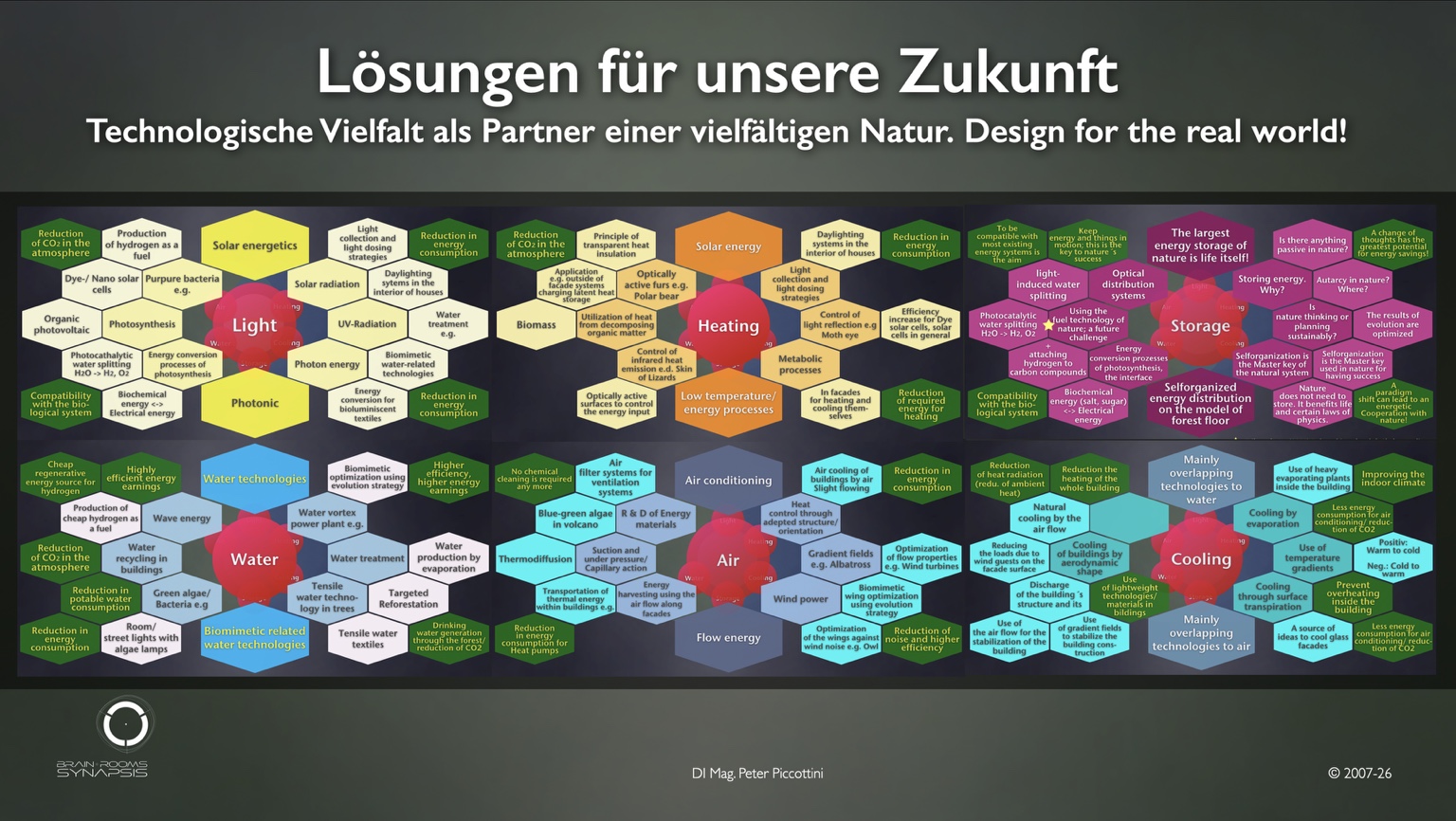
The Biomimetic Energy Strategy places Biomimetics in Energy Systems on a broader systemic level. It originated in an early mind map from 2007, in which water, light and heat were connected with storage processes, photovoltaics and self-organisation.

This mind map reveals the conceptual origin of the strategy. Here the discipline does not arise from a single technical idea, but from the interconnection of energetic processes. Coupling is decisive: water with heat, light with storage, surfaces with regulation.

A strategy matrix developed from this basic structure. It links natural models with technical applications and fields of action. The aim is not one future technology, but technological diversity that works as a system.

The Biomimetic Energy Strategy asks how technical energy systems must be organised if they are to become robust, adaptable and capable of development. It examines the coupling of energy flow, storage processes and system architecture.

Energiebionik – Das Mind, Ur-Mindmap 2007
Biomimetics in Energy Systems – The Mind. Original mind map for the Biomimetic Energy Strategy, 2007.
Lösungen für unsere Zukunft – bionische Energiestrategie
Solutions for our future. Development towards the strategy matrix for Biomimetics in Energy Systems.
Technological field of application

bionsphere – das Bionische Haus®

A concrete technological field of application of Biomimetics in Energy Systems is bionsphere – das Bionische Haus®. It transfers biomimetic principles to architecture, building technology and technical system integration.

The Biomimetic House is not conceived as an isolated building. It is a coupled technical system in which energy, light and heat interact functionally with material, envelope and use.

This distinguishes the Biomimetic House from a conventional low-energy or net-zero building. Its ambition is not confined to a favourable energy balance. It combines modular architecture with adaptive envelope and wall concepts. Light guidance, capillary technology and dynamic water storage are conceived as technical system components.

As a research and demonstration environment, bionsphere supports the development of new biomimetic materials, façade systems and building technologies. It shows how Biomimetics in Energy Systems can be translated into technical space: not as a symbol, but as a system.

Das Bionische Haus – Konzeptskizze
The Biomimetic House – concept sketch.
Verankerung

Scientific and institutional foundation

The scientific formulation and institutional establishment of Biomimetics in Energy Systems are closely linked to Villach, Carinthia University of Applied Sciences and the master’s programme Bionik / Biomimetics in Energy Systems.Bionik / Biomimetics in Energy Systems verbunden.

Peter Piccottini formulated Biomimetics in Energy Systems as an independent scientific discipline and developed its academic and institutional profile within this programme. It was the only degree programme in Austria devoted to this field and one of the few internationally visible institutional settings in which the discipline was established at the time.

The programme educated 77 graduates. Its profile brought together Biomimetics, energy systems and technical application in a distinct field of study.

Its development took place in professional exchange with influential figures in Biomimetics and energy research, including Prof. Helmut Tributsch and Biruta Kresling.

bionikum:austria and the Scientific Society

In 2012 Peter Piccottini initiated and co-founded bionikum:austria as an umbrella organisation for Austrian biomimetics research. The association was later renamed the Scientific Society Bionikum Alpen-Adria.

Peter Piccottini has chaired the society since its foundation. Prof. Helmut Tributsch supported its development as deputy chair from 2012 to 2021. Anja Boisselet has held this position since 2021.

A transnational network

The Scientific Society Bionikum Alpen-Adria sees itself as a transnational biomimetics network in the Alps–Adriatic region. Its members include experts and interested professionals from Austria, Italy, Slovenia and Germany.

In 2025, the transdisciplinary educational platform brain rooms synapsis emerged from this environment. It carries scientific knowledge and the modes of thought of Biomimetics in Energy Systems into spaces of education, experience and communication.

Education

Education and project development

Biomimetics in Energy Systems requires communication. Its way of thinking must enter higher education, schools, project work and public learning environments. This work is part of the discipline’s development because it makes systems thinking and technical understanding accessible.

Anja Boisselet is a graduate of the master’s programme Bionik / Biomimetics in Energy Systems at Carinthia University of Applied Sciences in Villach. Since 2021 she has served as deputy chair of the Scientific Society Bionikum Alpen-Adria. At the University of Graz she works in teacher education.

Teaching and supervision are also part of communicating Biomimetics in Energy Systems. Peter Piccottini taught in the Bionik / Biomimetics in Energy Systems programme and supervised numerous master’s theses, diploma projects and pre-academic papers as first or second supervisor. Together with Anja Boisselet, this educational work now ranges from university teacher education and school project supervision to funded development projects.

The educational work also includes diploma projects and initiatives at HTL Villach, among them current work connected with brain rooms synapsis. Another example is the FFG project B.A.U.M. Its idea and scientific basis originated with Peter Piccottini; project development and management translate this mode of thought into a concrete educational and development format.

Anja Boisselet has also addressed the communication of biomimetic knowledge in her publications. Her books are presented in the Books section of the home page and form an important part of this educational line.

Kurz erklärt

Frequently asked questions about Biomimetics in Energy Systems

What is Biomimetics in Energy Systems?

It is a scientific discipline within Biomimetics. It investigates energy conversion in organisms, structures and systems and derives technologies, strategies and processes for technical applications.

How does it differ from biomimicry?

It does not imitate external forms. It investigates energetic principles: conversion, storage, regulation and coupling in natural systems.

What does Biomimetic Energy Strategy mean?

The Biomimetic Energy Strategy applies this mode of thought to technical energy systems. Its focus is on coupled energy flows, storage processes and system architecture.

What is bionsphere – das Bionische Haus®?

bionsphere is a technological field of application. The Biomimetic House combines architecture, building technology and technical system integration in a research and demonstration environment.

Buchreihe

The book series Biomimetics in Energy Systems

The book series Biomimetics in Energy Systems continues the scientific work in published form and develops the discipline across several volumes.

Volume 1 begins with solar energetics. Light is considered not merely as an energy source, but as an organising factor in planetary and biological energy processes. The subsequent volumes extend this perspective to form, rhythm and cycles.

The series presents Biomimetics in Energy Systems as a coherent field of thought and research. It connects scientific foundations, biomimetic method and technical application. Its central concern becomes visible: the development of technical systems that understand, organise and use energy differently.